
Commerce
A complete system to run a business — webshop, order fulfillment, inventory, CRM and bookkeeping in one.
Commerce is — if I had to pick one — my magnum opus. It's the combination of literally everything I've seen, lived through and heard on the island. The base is Shiloh POS, plus FZMR (Warehouse Registration) — an internal application I built at OLB (Openbaar Lichaam Bonaire, Bonaire's local government body) for the FZ (Facility Services) department — and a program I wrote last year for the Dia di Rincon committee to digitise the stall registration.
It's basically a webshop AND everything behind it — or the other way around: a system to run a business, and what modern business doesn't have a webshop? Hence this fusion.
Does this interest you?
Voting is the main way to help me — it tells me where the interest is and where to put my time.
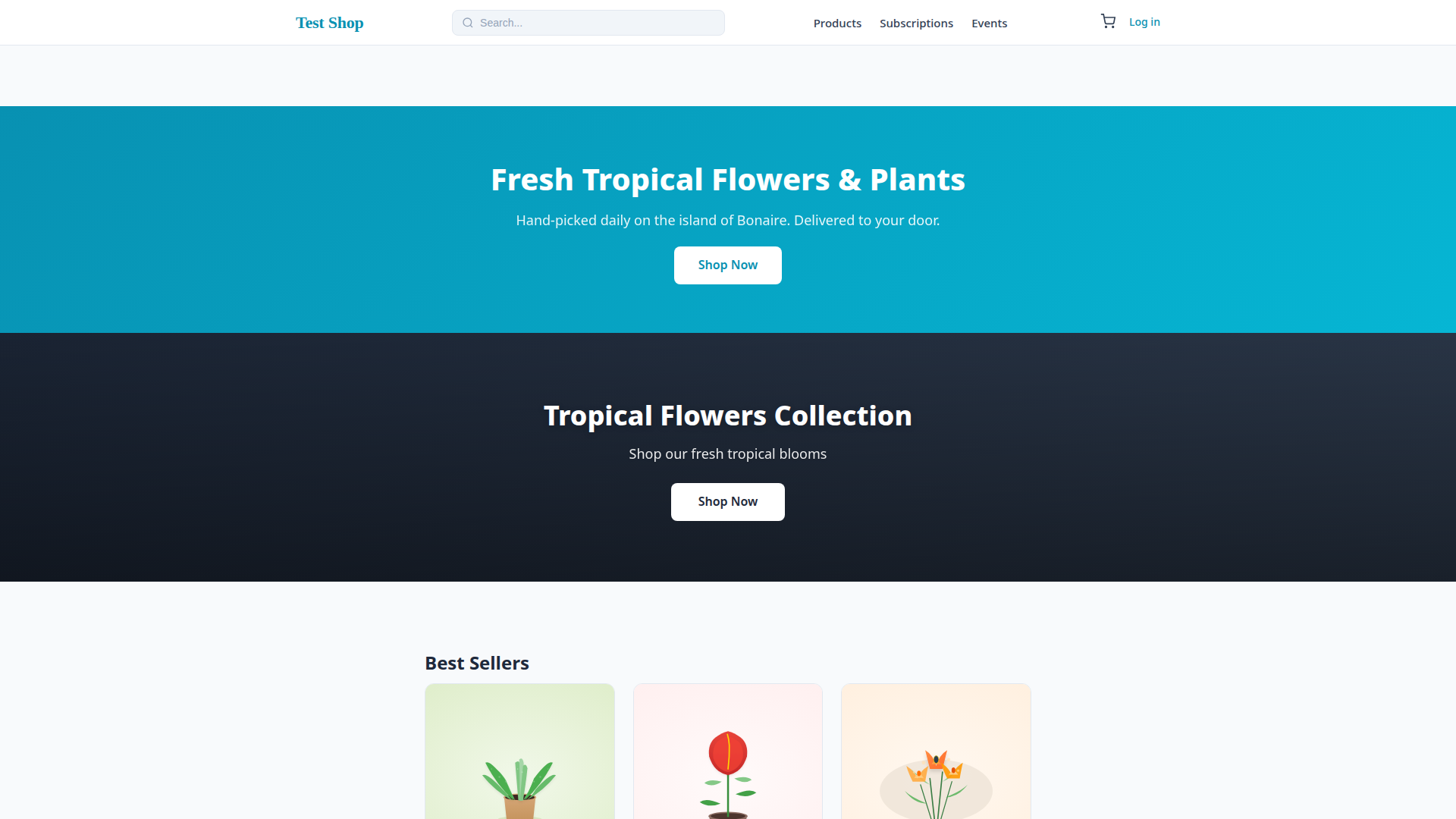
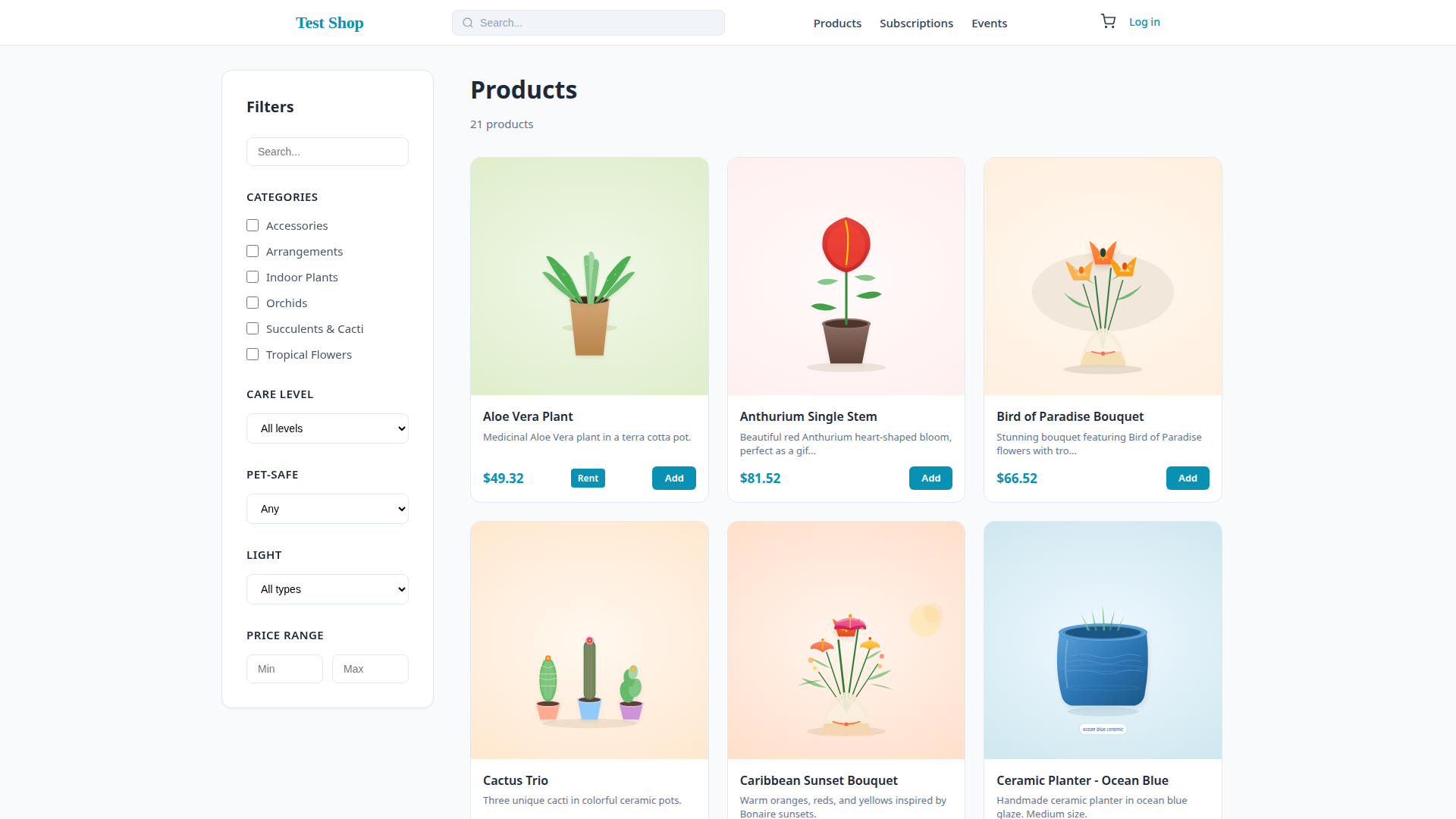
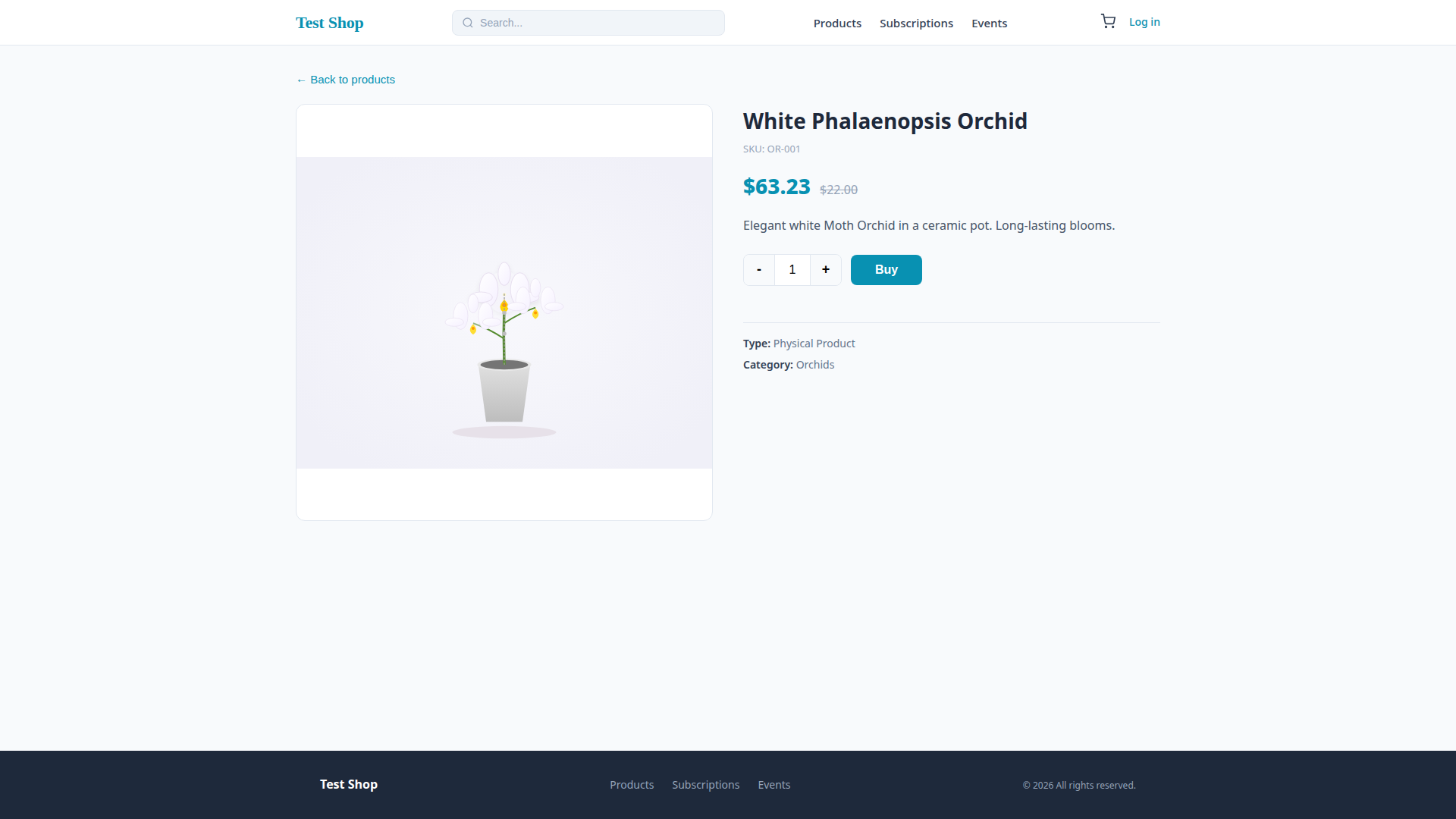
Or send me a message — i'd like to take part or ask questions +
Commerce is split into two parts: what the customer sees, and what the staff see.
Customer side
Customers can buy products, rent them, sign up for subscriptions, or register for events. For renting you pick the term, for buying the quantity, for events the ticket type. For certain products a personal message can be sent along — a wish that came out of the day-to-day at the flower shop.
The webshop itself is fully under the owner's control: pages, menus and content can be built and adjusted through a CMS. So what you see in the screenshots is one business with its own settings — every other business looks different.
Order fulfillment
The system revolves around the principle of order fulfillment — fulfilling an order. An order isn't always a single moment. Take a wedding at the flower shop: corsages get delivered to one location, the bridal package to another, and the decoration to the wedding venue itself. One order, multiple fulfillment moments.
Those fulfillment moments are the basis of the day overview for staff — every day you see exactly what needs to be fulfilled that day. Customers indicate when placing the order when they want something picked up or delivered, by choosing a block. The size of those blocks is set by the business owner: for one business 4 hours works fine, another wants precise 15-minute blocks — it's all in the settings.
Product model & purchasing
Products can be part of other products. A cake consists of a certain amount of flour, water, butter and sugar — and possibly labour as a separate product. Base products you purchase are in the system, even if you don't sell them directly to customers.
The advantage: if a purchase price changes, the system sees that the sale price of the composite product should ALSO change. You can lock a price (and get warnings about your margin developing) or let it float (so the sale price follows automatically). Prices can optionally be rounded to round numbers — nobody wants to pay 94 cents.
That way you automatically build up a historical overview of your purchase prices and margin — and by sharing purchase prices via Shiloh Market we can all see where a product is cheapest.
A purchasing module lets you scan invoices or receipts — invoices usually fit purchase amounts better — after which stock is automatically updated. Stock movement can also be done manually — for loss, damage, or write-down.
Customisation
Order statuses, their transitions, and which emails go out at which status or transition — all of it is configurable. Because of that your work becomes mostly tracking state in the system, while the system handles the communication.
Groups, classes & teachers
Within the CRM, contacts can be grouped. A group can be a customer segment (VIP customers, subscribers) but just as easily a class — think of dance, music or theatre classes at an after-school provider. Groups can be reached via newsletters and broadcast emails, and teachers are separate roles that can be linked to classes.
This part came out of conversations with the School of Performing Arts and is meant to automate enrolment, scheduling and communication between parents and teachers — after-school activities, that is, not regular education. The foundation is there; with enough interest this can be developed further.
Hosting & latency
Right now everything runs on European servers. For a user on Bonaire that means every click has to make a round trip across the Atlantic — and you feel that in the latency.
The big dream is a data center on Bonaire where Commerce runs as a cluster, with peering between all the local internet providers. Then the system talks on both sides with the user over the local network — minimal latency, no dependency on international lines.
Separate from that, Commerce can also run on your own server. Businesses that prefer to keep their information close don't need to wait for a data center — that's possible today, if needed on a computer at the owner's house. If you want your webshop to be publicly reachable, you need a more stable internet connection and arrangements with your provider — a trade-off everyone is free to make.
Offline operation
Internet on Bonaire is patchy and sometimes drops out. In Commerce's design, deliberate choices have been made so the system can eventually run offline at a certain level — the staff side then keeps transactions locally and syncs once there's a connection again, on your phone or computer. A publicly reachable webshop by definition needs internet, so that side can't do this; it's about the internal operation.
Connection with Shiloh Market
A Commerce instance can optionally be linked to Shiloh Market. When you do that, you get two things at once:
- Shared marketplace — your products appear on one central marketplace where customers can find and buy everything from all connected businesses side by side.
- Shared purchase prices — your purchase prices can, if you choose, feed into a shared view that lets connected businesses see together where products are cheapest to buy.
So the link isn't an obligation but an invitation. Anyone who'd rather run on their own does just that. Whoever joins in helps the broader network function better — and gets better helped themselves. More on that on the Market page.
Does this interest you?
Voting is the main way to help me — it tells me where the interest is and where to put my time.